10 Fascinating Facts About the Okapi
The okapi is one of the world's most mysterious animals. Here are 10 incredible facts that reveal why this rare rainforest mammal is truly one of nature's most remarkable creatures.
1. The Okapi Is the Giraffe's Only Living Relative
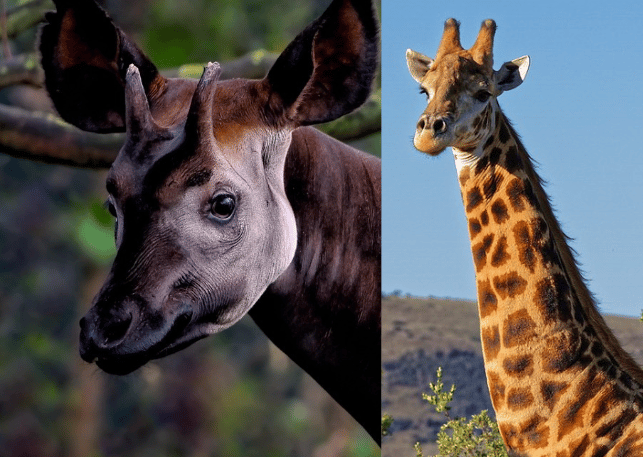
Did you know okapis and giraffes are the only two living members of the Giraffidae family? These remarkable relatives diverged from a common ancestor 11.5 million years ago.
Despite looking completely different—okapis resemble a zebra-horse hybrid while giraffes are towering giants—they’re actually closest relatives. Giraffes evolved for open savannas, okapis for dense rainforests.


2. Okapis Have Extraordinarily Long Prehensile Tongues
Okapis have an 18-inch (46 cm) dark blue-black tongue they can use to clean their own eyes and ears! This prehensile tongue strips leaves from rainforest vegetation with precision.
The dark color comes from melanin, providing UV protection during long foraging sessions in the forest canopy.


Only male okapis develop ossicones—those distinctive horn-like structures covered in skin and fur. These grow less than 6 inch (15 cm) long and show male status. Females have hair whorls instead, creating clear sexual dimorphism unique in the Giraffidae family.
3. Only Male Okapis Have Ossicones (Horn-Like Structures)
Key Takeaway: The okapi is scientifically classified as the giraffe's only surviving relative, making it one of nature's rarest family connections.
Key Takeaway: Okapi stripes are evolutionary masterpieces of rainforest camouflage.


4. Okapi Stripes Provide Perfect Rainforest Camouflage
The bold white horizontal stripes adorning okapi legs and hindquarters aren't just beautiful—they're essential survival tools. These stripes disrupt the animal's outline in fragmented sunlight filtering through the dense forest canopy. This disruptive coloration pattern, called "dazzle camouflage," renders okapis nearly invisible to leopards and other forest predators in their native Ituri Forest habitat.
5. Okapis Are Completely Solitary Animals
Unlike social mammals that live in herds or groups, okapis are fiercely independent. These solitary animals maintain exclusive territories averaging 13 km² for males and 3-5 km² for females. They interact with other okapis only during mating season, spending the rest of their lives roaming the forest independently within their established home ranges. Occasionally, small feeding aggregations form at high-resource sites.
Key Takeaway: Okapis are solitary by nature, preferring solitude to social interaction.
6. Okapis Were Unknown to Western Science Until 1901
The okapi remained a complete mystery to Western science for centuries. Local Congolese peoples had known about these animals for generations, but scientific discovery didn't occur until 1901. British explorer Sir Harry Johnston obtained specimens—including striped skins and a skull—which he presented to the Zoological Society of London. This remarkable discovery revealed an entirely unknown species to the scientific community.
Key Takeaway: The okapi was scientifically unknown until just over 120 years ago, despite being known to indigenous populations for centuries.
7. Okapis Are Selective Herbivores With Specialized Diets
Okapis feed on over 100 species of plants, making them incredibly selective eaters. These strict herbivores consume approximately 45-60 pounds daily of leaves, buds, ferns, fruits, and fungi from understory vegetation. Beyond leaves, okapis exhibit remarkable dietary flexibility by consuming clay from riverbeds for mineral supplementation and occasionally bat guano for essential nutrients.
Key Takeaway: Okapi diets are diverse, selective, and include surprising nutritional sources like mineral-rich clay.
8. Okapis Have an Extraordinarily Long Pregnancy
Okapi mothers endure one of the longest gestation periods among rainforest animals: approximately 440 to 450 days—nearly 15 months! This extended pregnancy allows the calf to develop fully so it can stand and nurse within just 30 minutes of birth. Newborn calves weigh between 30-65 pounds (14-30 kg) and are born with extra-long hairs around their eyes—resembling false eyelashes—a feature that disappears within their first year.
Key Takeaway: Okapi pregnancies are nearly 15 months long, producing remarkably advanced calves ready to survive the rainforest.
9. Baby Okapis Remain Silent During Their First Weeks
Newborn okapis possess remarkable survival adaptations that enhance their chances of avoiding predation. Calves remain nearly silent for several weeks after birth and do not defecate for approximately 40 to 60 days—a remarkable evolutionary adaptation that minimizes olfactory detection by leopards and other forest predators. These cryptic behaviors, coupled with their mother’s protective absence while she forages, provide crucial protection during the vulnerable early months of life.
Key Takeaway: Young okapis employ silence and behavioral adaptation as predator-avoidance strategies.
10. Okapis Communicate Through Specialized Scent Glands
Chemical communication is essential for okapi survival and territory maintenance. Okapis possess interdigital scent glands on all four feet that deposit tar-like secretions marking territorial boundaries. Males supplement foot-gland marking with urine spraying, while communal defecation sites serve as additional chemical message centers. These sophisticated scent-marking behaviors allow okapis to communicate presence and territorial claims without direct contact.
Key Takeaway: Okapi scent glands enable sophisticated chemical communication across rainforest territories.
Key Takeaway: An okapi's blue-black tongue is one of nature's most specialized feeding adaptations.
Key Takeaway: Okapi ossicones are exclusive to males and differ significantly from giraffe horns.
Protecting Okapis: Why These Animals Matter
Understanding okapi facts is the first step toward conservation action. As the giraffe's only living relative and a critically endangered species, okapis deserve global attention and protection. Supporting wildlife conservation organizations working in the Congo Basin represents the most effective way to ensure these remarkable animals survive for future generations.
Check out more about this project in the link below